To the pain

I Can Make The Pain Disappear – Fear of Tigers

A very strange post from Pema Levy at The American Prospect.  The premise is that states are attempting to challenge Roe v. Wade with a lot of niggly abortion regulations, to slowly ratchet up legitimate restrictions in the hope of developing a long-term rollback of Roe.  So far, there’s nothing weird about that point.  It’s a very real, and very problematic feature of the contemporary reproductive rights debate.

The peculiar part is Levy’s particular beef with a bill in Minnesota that seeks to bad abortion at 20 weeks because that’s when the fetus theoretically starts to be able to feel pain.  Levy: “what is perhaps so extraordinary is the assertion that physical pain is something a legislature should try to prevent.”  She then goes on to say “Spinal taps are excruciating, but they also save lives, as do countless other procedures. Should we ban them? As a doctor, pain shouldn’t play into medical decisions, period. It’s important to make this point.”

This is, quite frankly, ludicrous.  Doctors should have no  interest in reducing pain?  Tell that to millions who suffer from chronic pain who go to their doctor seeking relief.  Tell that to people trying to get marijuana legalized at least as a palliative measure.  Centuries of utilitarian thinking certainly matter here too.  Pain matters quite a bit for making judgments of public policy.

In Levy’s world a doctor should not feel any threat to her Hippocratic Oath if asked to torture someone in a manner that won’t produce any physical harm?  After all, it’s mere pain.

Quality of life matters, and it matters a lot.  Legislatures absolutely should concern themselves with increasing it.  And part of that is curtailing pain.

The problem with Minnesota’s legislation is not that it uses pain as a justification for public policy.  It’s that it uses the theoretical pain suffered by a fetus that is not a person by any existing legal standard as a trump card to overwhelm the pain of the potential mother.  And even if you decided the fetus should have legal standing as a person, you can still accept that legislatures should work to reduce pain without believing that the proper mechanism is to coercively regulate the bodies of women.

Posted in Uncategorized | 1 Comment

You can taste the fear

Intervention – Arcade Fire (live on KCRW)

People really love (for other people) to fight wars. Even people who are otherwise strongly committed to liberal or left-wing values. This post from Jonathan Chait is a prime example. He says “I’m mindful of my lack of relevant expertise, but the case for a no-fly zone and arms shipments to the rebels seems more compelling than the case against. It’s the possibility of a disaster against the likelihood of one.”

And then he goes on to say “Second, the Obama administration’s decisions in Iraq and Afghanistan show that it’s obviously not allergic to the use of military force.” This seems like an irrelevant point. Does anyone seriously think that Obama would have initiated these wars had they not already been started when he entered office?

I’m not categorically opposed to the idea of a no fly zone, but let’s not mince words here. If we’ve learned anything from the previous decade it’s that military interventions are never as simple as they seem. And if we learned anything from the PREVIOUS decade it’s that intervening in non-European parts of the world is likely to provoke significant blowback both at home and abroad—often forcing disentanglement on worse terms.

If you want to make the case that Libya is equivalent to Rwanda, it seems like you have quite a steep hill to climb for making that argument.

And even if you think there is a good case for intervention, it is irresponsible in the extreme to ignore the context of OTHER arguments for reform. That is: who are your allies on this issue? What are their objectives? If you both agree on a no fly zone, is it because you see our relationship to Libya, democracy, the Middle East, etc. in exactly the same terms? Presumably not. So if we DO get involved, who is actually going to assert control over the development of that intervention?

I’m willing to be persuaded that we ought impose a no fly zone. But our presumption should be strongly against this premise. Not out of a status quo bias (as Chait assumes) but because the rush to military response has all kinds of hard-to-quantify biases built into it.

I’m much more interested in people taking these points seriously BEFORE military action than I am in heartfelt mea culpas and investigations of what went wrong in the aftermath (c.f. widespread liberal support for the Iraq war). It’s really easy to get caught up in the moment. We owe it to ourselves, to the people of Libya, and to the world at large to remain cognizant of this.

Posted in Uncategorized | Leave a comment

The state of the blog

Well, the state of the blog is: steady.  This post promises no significant changes or major events.  It’s really just to say that the new version of the blog–the one where I post irregularly but more than just once or twice a month–is likely to continue as far as I can predict.  And to make a couple smallish announcements:

– The visitor log is inching ever closer to 400,000.  That’s awesome.  Thanks everyone who has stopped by over the years and contributed to that number.  We’ll shoot for 500,000 next. Half a million is a lot of people.

– The blog also passed its fifth birthday a month or so ago, with no fanfare whatsoever.  It’s pretty crazy that this thing I started on a whim back then is still chugging along.

– I’ve finally joined the 21st century and joined the Twitter-craze.  No promises about keeping it up, or having anything particularly interesting to say, but you can follow me @olneyce.

– Newer visitors might not be aware of the only truly interesting thing I’ve done on the blog: rank every Beatles song from worst to first.  Unfortunately, the move from Blogger to WordPress killed all the comments those posts used to have, which makes me sad.  So please, go read, and yell at me for putting your favorite song at #63, or commend me for my brilliance, or tell interesting stories about the songs.

– Still don’t get Radiohead.  The King of Limbs bores me to tears.

– I have, however, really been digging this Phil Ochs cover:

When I’m Gone – Thea Gilmore

Posted in Uncategorized | Leave a comment

Days go by with no delay

No Delay – The 1900s

So, what’s the deal with filibuster-critics and the current Wisconsin stand-off? Presumably people who were angry about obstructionism in the national Congress should be equally critical of these acts, at least if they were espousing genuine principles.

There is something to this. But I want to offer a couple thoughts that insist on a bit more complexity.

The first easy response is: I object to counter-majoritarian elements within legislatures in principle but as long as they exist I’m not willing to unilaterally disarm. This is obviously a self-serving argument, but I don’t think that renders it completely invalid. It is quite possible to be hypocritical at the level of particularity but still retain credibility at the larger scale. The ‘disarmament’ metaphor is perhaps apt here. A truly genuine commitment perhaps should insist on unilateral disarmament but standard practice is to accept that the principle may be sound but the means for reaching it must be more circumspect.

Still, if that was the only argument here, I wouldn’t find it tremendously persuasive. It’s very easy to criticize and even more easy to fall into the same habits once they serve you personally. But it’s very difficult to walk the line of exploiting while remaining critical.

Fortunately, there’s another reason to see a serious difference here. Most people concerned about the filibuster are MUCH more concerned about the routine ease of its use than they are absolutists about the principle of pure majority rule. The principle that Congress ought to have the capacity to gum up the works in extreme cases is reasonably defensible.

An institutionalized filibuster puts zero burden on the party conducting it. It’s up to the other side to either round up 60 votes, or simply move on.

The case in Wisconsin is different. The Democrats have to pay a serious cost. They are shutting down the entire operation of government on spending issues, and are removing themselves from non-spending issues. This is not something they could duplicate on any old piece of legislation. It must be reserved for issues where forcing delay has a genuine purpose. In this case, they thought the public would rally behind them if they had a chance to raise the issue to a significant level of discussion. It seems like they might have been right.

But if the public had, after a week or so, clearly supported the bill they would have absolutely destroyed their own credibility if had they continued to hold out.

There is no definitive right answer to how much power a minority (or what size minority should be required) to block the normal function of majority rule. But if you’re trying to justify a standard, what’s happening in Wisconsin is MUCH easier to defend than the Senate’s filibuster rules.

If you want to find a way to lock down future applications of fleeing to block quorum calls, you might simply impose a rule that the number of people necessary to make quorum should decline after a set period of time. Say, a month?

I certainly don’t think that the Wisconsin 14 should stay away indefinitely, nor that they should employ this tactic with any kind of regularity. But I really have very little concern that this will actually happen. The costs are simply too high. Again, not personal costs (having to live out of state for a while! oh noes!), but institutional and electoral ones (inability to pass other, good laws and the likely growing voter backlash at over-application of the tool).

Posted in Uncategorized | Leave a comment

Time is best when it stops

A Telegram From the Future – The Russian Futurists

The question is posed: who will still be famous in 10,000 years? This intrigues me.

The major caveat is that 10,000 years is just an insane amount of time. That’s basically equivalent to the entirety of human civilization so far. Thinking that far ahead is like trying to guess who will be president in 2196. It’s not just that you can’t possibly know who will be around at that point–you can’t even been sure the US will exist or that it will still have ‘presidents.’ So we’ll just have to assume that aliens don’t kill us, or that the singularity doesn’t vault us into a higher dimension, or that we don’t go all Canticle for Leibowitz on each other.

With that said, I think there are a few solid answers. The religious folks: Jesus, Muhammad. Abraham, if we consider the historical Abraham to have genuinely existed. Buddha. Confucius has lasted 2500 years so I don’t see why he couldn’t go another 10,000.

I’d like to believe some art will survive. Shakespeare, for one. Homer, perhaps. Though Homer isn’t necessarily a ‘person.’ You’d have to imagine that people will still be keen on philosophy (10,000 years doesn’t seem like long enough to have answered any of those questions) so Plato will surely still be around. The Beatles? I’d have to say yes – though perhaps in this form only.

Who else?

Posted in Uncategorized | 6 Comments

This is what we talk about when we talk about debt

I’ve made the point before that when people complain about deficits they don’t really mean deficits. Obviously that’s not universally true, but in these moments when ‘deficits’ or ‘debt’ become significant political issues they are often simply a stand-in for concern about a bad economy.

This video (linked to in this Slate column) reminds me of one of the classic examples of this phenomenon. It’s from a town hall debate in the 1992 presidential campaign.

The woman asks how the debt affects each candidate personally. There is confusion. Of course the debt doesn’t affect them personally so how are they supposed to respond? It’s only resolved once you realize that she really just means the economy. How have the tough economic times affected you personally?

Even if you believe that the debt is a proximate cause of economic decline, that’s very different from treating them as synonymous. The conflation of the two is particularly disastrous in circumstances where short-term spending is the way out of recession.

I think our political discussions would be significantly improved if we didn’t take the surface-level account as the definitive truth and instead pressed just a little bit to see what lies underneath. For another example, see this post from Jonathan Bernstein asking for a bit more investigation of the apparently shocking fact that a majority of likely Republican primary voters are birthers.

Posted in Uncategorized | 3 Comments

Watch the decline from a hazy distance


How The West Was Won And Where It Got Us – R.E.M.

(from the strangely underrated New Adventures in Hi-Fi, which is probably my second-favorite R.E.M. album)

Okay, so I’ll admit I got bored and stopped partway through, but this New Yorker piece on Scientology left me pretty underwhelmed.  I’ve seen a lot of people linking to it as if it were the definitive piece proving the craziness of Scientology.

I don’t see it.

I mean, sure, they’re crazy.  But they don’t seem all that far beyond the run-of-the-mill craziness of religion in general.  You have to accept a bunch of thing that seem irrational, but having faith is kind of the name of the game.  And they definitely have a bit of the feel of an insular group, unaware of social trends and set in their retrograde ways.  What else is new?

Paul Haggis got a lot out of them, and they got a lot of out him.  He changed his mind and became an apostate. So it goes:

The story is a sad one, told many times.
The story of my life in trying times.
Just add water, stir in lime.
How the west was won and where it got us.

And frankly, Haggis was at least able to create Due South while being a Scientologist, so it can’t be all bad.

Due South Theme

Posted in Uncategorized | 1 Comment

You don’t know the way to his heart


Sister WifeAlex Winston

Strangely appealing, yet impossible to fully comprehend. The sort of song you want to listen to with some regularity, but definitely would not want to be stuck in a monogamous relationship with. Fittingly, the subject of the song is polygamy.

How to describe it? Well, she has one of those magical-forest-pixie voices that simultaneously tantalizes and perplexes. Musically, it’s fairly standard infectious indie-pop, with some big drums and an even bigger chorus.

In a slightly different vein–with handclaps!–here’s a great video of “Choice Notes,” her minor hit from last year, much improved for being stripped of the heavy weight of studio production:

Posted in Uncategorized | 1 Comment

Hey, where you going, I forget

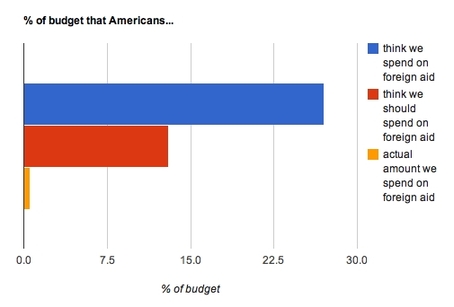
Graph from: The Plum Line

Relative Surplus Value – The Weakerthans

It’s a pretty common lefty-blog feature to point out that the American public is totally incoherent when it comes to governmental spending. And with good cause! People generally state preferences that wildly contradict with no apparent awareness of this fact.

The general premise is that everyone wants to cut wasteful spending and reduce deficits. But when faced with a variety of specific questions about what to cut, clear majorities favor retaining spending on virtually everything. And even on those few things that majorities think should be cut, there are still very silly elements. One example is the report discussed here, which points out that foreign aid is one of the only things people want to cut. However:

In a World Public Opinion poll conducted last November, respondents guessed, on average, that foreign aid spending represented 27% of the federal budget. To trim spending, the same respondents suggested that, on average, foreign should make up a slimmer 13% of the total budget, surely delivering massive savings.

The problem? Foreign aid is actually a minuscule 1% of the total budget. Even eliminating it altogether would do little to balance the budget or reduce the deficit.

Right.

That is all totally fair, but I want to make two points that might help to at least reduce the confusion and maybe will redeem the American people at least a little bit.

First, I think it’s important to remember that when people complain about ‘deficits’ it very rarely means they actually care that much about deficits. What they don’t like is a bad economy. The thing is: the economy is unbelievably complicated. I study politics for a living and read a lot about the economy and still find myself completely lost when trying to go beyond the fairly basic stuff. For people who devote significantly less attention, it’s not at all surprising that they speak in a sort of shorthand. The one thing that was pretty commonly agreed upon in the 70s and 80s was that federal spending commitments had gotten out of control and contributed to the serious inflation problems that hit the country.

Of course, it’s more complicated than that. But there’s enough truth there to pass the smell test. And it works at a gut level, too. When times are tough for individuals, the responsible thing to do is cut back on your spending. It’s just common sense that governments ought to be doing the same. And the money they’re using is taxpayer money! So it’s doubly offensive for them to be profligate while common people suffer!

What’s missing from that morality tale, of course, is that governments aren’t people. They don’t spend money to increase their own utility.* The money they’re spending is (at least in principle) going toward improving the social conditions of the whole country. And the task of a government in tough economic times is to serve as a counterweight to the individually rational decisions to reduce spending (and thus reduce liquidity). But that’s a complicated argument. And as long as things are bad people are unlikely to want to listen to it.

You’ll find that as economic conditions improve people’s worries about the deficit fade tremendously. That doesn’t really make sense unless you accept that, for many people, ‘I’m worried about deficits’ is a stand in for ‘fix the damn economy!’ There are genuine deficit hawks, of course, but they are nothing close to a majority. We can keep feigning astonishment at this phenomenon if we want. But it’s almost as silly as the people who claim to care so much about spending while refusing to cut any spending.

The second point pertains to the foreign aid example. It is, of course, an important point that people monumentally overestimate the amount of money we have going to foreign aid. And it’s worth pointing that out. But I often see people taking this example as evidence that the public would actually support more spending on foreign aid, or at least doesn’t ‘really’ want to cut foreign aid.

I think that misses the point. People are terrible TERRIBLE judges of absolute numbers. We are much better at relational assessments. That means that when people said they thought foreign aid should be 13 percent instead of 27 percent they didn’t really mean it should be 13 percent. They meant that we should cut foreign aid in half.

I bet that if you had said ‘let’s say foreign aid is 20 percent of the budget, how much ought it be?’ they would have said 10 percent. Or if you had said 10 percent they’d counter with 5 percent.

The point is not that we should listen to people and cut foreign aid spending in half. It’s just that we should take all these ‘public opinion’ surveys with about 27 grains of salt. They DO tell us things, but it’s often not the things that show up on the surface.

* Yes, yes, institutionalism tells us that governments do in fact take on personalities and interests that are detached from their representational origins.  And bureaucracies, in particular, as susceptible to path dependency and capture by particular interests that then work hard to sustain spending for wholly internal purposes.  This is all true, but is still a relatively minor subset of what we’re talking about.

Posted in Uncategorized | Leave a comment

I can tell by the look in your eyes


All Die Young – Smith Westerns

It’s pretty easy to get into my good graces. While I have my occasional pretensions to being a musical sophisticate, when it all comes down you really just need to remember a couple simple things. 1) The Beatles are great. 2) You’re not as great as The Beatles so don’t shamelessly rip them off. 3) But if you can steal a little something, and give it some real spirit, you’ll go far.

“All Die Young” puts this 3-step plan to the test, and come through with flying colors. Sonically, it’s not really a Beatles knockoff so much as it’s an ELO knockoff. Big psych-drenched slide guitar movements, bombastic presentation, and a singer who is a dead ringer for Jeff Lynne. What’s not to like? But while the first half of the song is plenty good, the thing that really kicks it into the stratosphere is the final third, which totally rips off the coda of “Oh Yoko” but does it with sure assuredness and passion that you just can’t help but love it.

Smith Westerns used to be a fuzzy garage rock band, but they’ve got a label and cleaned up apparently. The record is called Dye It Blond.

Posted in Uncategorized | Leave a comment