The Romney gaffes

World Spins Madly On – The Weepies

Alright, so we’re a little bit removed from the blowback surrounding a series of very stupid Romney comments. While I can’t help but feel just a little bit of glee about these things, I do want to talk a little bit about whether this stuff really matters. Unsurprisingly, I think that the effect is both understated and overstated.

It’s overstated in ways that are pretty obvious. This kind of thing doesn’t reveal who the ‘real’ Romney is. It doesn’t give us a window into his soul, nor does it clarify what the Romney administration would look like. Taken in a loose fashion, there is something to this argument, just not a whole lot. That is: it is potentially relevant to notice that Romney reacted pretty rashly to the attacks in northern Africa, and prioritized politics in that response.

But those are actually pretty insignificant issues. Romney isn’t occupying any office right now. He doesn’t have any REAL responsibility to deal with those issues. It doesn’t tell me much about what he would do if he faced a crisis while in office. We’re currently in the midst of an election; of course he prioritized politics. ANY response would have prioritized politics. The only thing we really have to complain about is that he did a poor job of figuring out what the political effect would be. Which does matter, just not that much.

As for the 47% comments, they mostly don’t matter insofar as they are just a really bad phrasing for something that we pretty much already knew. To wit: Romney isn’t particularly interested in improving the quality of life for the poor and middle class—and he knows that his agenda won’t be targeted at those goals. Which is not to say that he ‘doesn’t care about those people.’ Obviously he wants their votes and doesn’t believe that if he were president it would be terrible for those people. He just doesn’t prioritize their problems.

But again, we already knew this. That he has now stated it in such a damaging way is important to the extent that it helps the Obama campaign make this argument. And it certainly helps that it’s a clandestine video, where the blue team can spin it as revealing his true hidden desires.

But in most cases, that’s just about the limit of the importance of a gaffe. It needs to allow the opposing campaign to make an argument they were already trying to make in a more damaging fashion to really have much lasting effect.

These two events certainly provide some of that, and if Romney does end up losing they will probably feature prominently in the postmortem. But I think they only really matter because other things were already going against him. And I urge caution to my liberal friends who see these gaffes as putting a nail in the coffin of the Romney campaign. Don’t get me wrong, I am certainly now more optimistic about Obama winning than I was a month ago. But this is by no means settled, and it remains quite close.

I’d say there’s about a one-third chance of the gap widening, and this turning into a secure and easy Obama win. But if that doesn’t happen, we could end up very similar to the 2000 and 2004 results, where it comes down to just a few votes in a few states. And at that point it’s anyone’s game.

Posted in Uncategorized | 1 Comment

So I keep lying to be honest

Tell Me Ten Words – Idlewild

Apparently the Romney campaign has decided that the ‘are you better off than you were four years ago’ question is going to be a big theme of their campaign. I get where they’re coming from here. It’s a metric that’s designed to frame the election as essentially a judgment about whether the incumbent deserves a shot to keep going. And given that the Romney campaign’s primary goal is to convince voters that they are just voting for Generic Republican, rather than a particular campaign, that makes a lot of sense.

Of course, the question itself is fundamentally stupid. It doesn’t really matter if you’re better off; the real question is ‘do you think you’ll be better off four years from now?’ After all, you don’t elect presidents in reverse. The point is to decide who will be the best option for the future of the country. And even if we were going to be retrospective, it would still be better to ask ‘are you better off now than you would have been with the other candidate?’ Elections, after all, are a comparison of options, not simply referenda.

It’s also silly for its faux-precision. The precise identification of a president’s term in office with his/her responsibility doesn’t make a whole lot of sense. After all, four years ago today the economy was still stumbling along, but in the following six months went through the biggest catastrophe it’s seen since FDR. That we’re basically back to where we were four years ago is a decently strong endorsement, actually. On the reverse side of things, Clinton skated to re-election in 1996 in part because the recovery which had started in 1992 was going full tilt by that time. But it’s kind of silly to give him full credit for that.

All that said, it’s a fundamentally stupid question that still has some reasonable grounding. It’s not a literal test, it’s more of a proxy question. Predictions about the future are notoriously difficult, particularly when it comes to the economy. So rather than expecting people to make complicated judgments about which economic approach is best-suited for a particular moment, you just use a very simple test ‘does your stuff seem to be working?’

It’s clearly not the best sort of judgment you could possibly put together, but it’s not a terrible thing for politicians to know that they’re going to get stuck with the blame for what happened on their watch.

Still, you’d hope that people would filter that general attitude through some understanding of the particulars. Which, to be fair, is I think what people generally do. They’re willing to hear some explanation of circumstance, but will only put up with a certain amount.

In the case of the 2012 election, it doesn’t take a lot of mitigating circumstances to make a strong case for Obama. The extremity of the inherited crisis, the lack of relevant solutions offered by Romney and co., the intransigence of the Republican opposition, and so on.

I’ve been watching The West Wing, and the campaign to re-elect Bartlet is essentially defined by one side churning out 10-word slogans, while the other side wants to debate the details. I really hope life imitates art and the simplicity of the 10 words ‘are you better off than you were four years ago’ is not enough to overwhelm everything else at stake. Like I said, it is totally reasonable to make a larger argument built around this premise. But the premise alone isn’t much of anything. If Team Romney is able to DO something with it, then they might be in business. Though, I’m not really sure what they CAN do without providing some more detail about how they can fix the problems better.

Posted in Uncategorized | 2 Comments

In defense of the conventions

Hi all, it’s that time of year again where election season kicks into gear. Which I guess means it’s time for me to get the blog back up and rolling. I’ve got a ton of good music to post about, which will come as soon as I can find the time. But election season really gets my hackles up, so it’ll mostly be political stuff for the next few weeks, as I take breaks from writing the dissertation and applying to jobs to write about whatever thing is infuriating me at the moment.

Today, it’s all the postmortem complaints about the conventions. They’re totally staged, there’s no real news, everything is a foregone conclusion, etc. All of those are true, of course, but why is that so damning?

Conventions used to fulfill one purpose, but now they do something different. If you’re expecting them to all be battles a la 1940 or 1968, you’re clearly going to be disappointed. But while the point of the modern convention is a lot simpler, it’s still pretty important. Namely, conventions are an opportunity for the candidates to present their best face, to communicate their story. The conventions start to lay out the key narratives for the last two months, they identify weaknesses and strengths. And, partly as a matter of timing, they signal an important point in the campaign. For a lot of people, the convention is the time to genuinely start paying attention.

Of course it’s all staged. But so what? Staging is a big part of politics, and we expect the people who are running for this office to be reasonably good at politics. If they can’t successfully put on a good convention, it’s not a very good sign for their candidacy. Much like the guy who doesn’t bother to shave or put on nice clothes for an interview, small failures on less important things provide a market of a larger unwillingness or inability to meet expectations when it comes to more important things.

Instead of complaining that the conventions have no real news, focus on the choices about what to emphasize, what to frame and what to ignore, how they include various elements of the platform, the detail of their commitments, etc. These things all ARE the news.

Posted in Uncategorized | Leave a comment

Over the fantastic fabrics of his mind

Near Light – Ólafur Arnalds

Songs composed and performed in a living room, made quickly and then immediately performed. It’s a gimmick, to be sure, but a gimmick that manages to work brilliantly.

Ólafur Arnalds is an Icelandic composer, who makes precisely the sort of music you’d expect on hearing that description. It has none of the bombast of Sigur Ros, but all of the attention to detail. In this case, the self-imposed limitations of environment and composition allow for a deep sense of intimacy and introspection.

There are two currents in my love for instrumental music. Part of what I enjoy is the simplicity, the elimination of artifice. I enjoy being able to to experience the sounds cleanly and let them wash over me. On the other hand, I also appreciate the intense capacity for layering and precision. The first category tends to include ambient and drone styles – where each note is given the space to breathe and exhume itself. The second category is more classical: Bach concertos and orchestral sweeps.

But the division is not quite so clean. The best work of one category is always informed significantly by the other. The complexity serving not to produce dense layers but rather to construct a platform on which the most simple forms are pushed to the front.

Living Room Songs is a great example of this symbiosis. What are at heart incredibly simple movements expand outward like crystal formations–moving at a glacial pace but taking on the most unexpected of hues.

The synth-keyboard which forms of the heart of “Near Light,” for example, is incredibly simple. It is literally 5 or 6 keys, struck slowly and deliberately. But somehow, in the surrounding mix, it sounds like a revelation.

“Ágúst” is similarly built around an incredibly basic progression on the piano. But the intrinsic solitude of that single piano line is enlivened by the delicate infrastructure of the strings. Together, they combine to suggest the frisson of doubt at the core of our daily routines: is this really all there is, to trace these steps over and over? But rather than casting a dark shade with that question, they invite you to see the depth of possibility in even the very simple.

“This Place Is a Shelter” is the quiet, perfect conclusion to the record. It’s the sound of safety, of knowing that there is at least one place in the world that is your own – and of the joy that comes from sharing it with those who matter to you.

Posted in Uncategorized | Leave a comment

I don’t know if the sting is from the salt or the lies

The Sting – Vanessa Peters
Copilot – Vanessa Peters

Vanessa Peters has been one of my favorite artists of the last few years, with two fantastic albums on the bounce (and a nice Christmas record last year). Her most recent album The Burn The Truth The Lies was just released and very much lives up to expectations.

It has a little bit less of the grandeur that some of her other work had displayed. But in its place is just a wonderful summer record, full of sun-dappled jangly guitars and choruses that are just begging to be hummed. Once you dig in a bit, you start to realize that it’s actually a bit darker than you’d first sensed. But after a few more listens, the fundamental optimism takes back over and you start to hear the stories about loss and doubt as part of a broader narrative about the importance of connections.

It’s the sort of record that would slot perfectly into a road trip, right in between an old Gram Parsons record and a new Aimee Mann one. Which is to say: it doesn’t really sound like the music of 2012, but neither does it sound old or dated. There’s a sort of timelessness to these sort of songs–I can imagine that I would have loved this record as a kid, but can just as easily picture myself sitting in a rocking chair listening to “No Decision,” content at a life well-lived.

It’s a record without any true standout songs; there are no single tracks that I find myself returning to much more than the others. For someone who is ever-more focused on single tracks–I live my musical life primarily through mixes–that sounds like a problem. But it’s really not. As much as I like to vary my musical experience, there’s something really wonderful about a record that really FEELS like a composite entity.

So while there is no one standout, there are plenty of highlights.

“The State I’m Living In” offers a sense of peaceful contentedness, hemmed in by a wonderful little acoustic rhythm and counterpointed with bit of slide guitar. “Grateful” is precisely what you’d expect from the title: a song that just makes you feel happy to be alive.

“The Sting” might be my favorite song on the record: quiet, beautiful, just a little bit ambiguous. It’s like falling in love just a little more quickly than expected. The bit of tension there–the recognition that you’re opening yourself up to real pain–is just part of what makes it special.

“A Good Judge” moves on at a deliberate pace–and there’s no sense of surprise when it finally breaks out of the shell at about 2:30, just the necessary next step.

“Copilot” embodies more than any other song the sense I discussed above: of happiness, tinged with a bit of dread, but ultimately emerging into the sunlight. A little bit weary, but happy to be there.

And that’s pretty much my takeaway from the whole record. It’s a real joy to get to experience it.

Posted in Uncategorized | Leave a comment

The values underneath strategic voting

Writing about Kagan and Breyer’s apparent decision to strategically join the majority on limiting Congressional spending power, Scott Lemieux is quite reasonable that such strategic voting is inevitable and even (marginal) desirable.  The Court is a political institution, and it’s silly to pretend like it’s not. However, ‘political’ is not an intrinsically dirty concept. If judges recognize their political responsibilities, they will be more likely to render good decisions. That is: decisions which reflect the unique TYPE of decision-making that judges are tasked with.

However, I don’t want to let this go too far. Just because judges are political doesn’t mean they are precisely the same as all other actors in the political process.

Or, to be more precise, I think politics ought to include a balance between genuine responsibility to constitutional/normative values and the strategic calculation that goes into the rough-and-tumble of coming to actual decisions. And right now the closest thing we’ve got to that is the normalized process of judicial rulings.

I think there is something unethical (though I don’t necessarily love the language of ethics to describe it) about reaching a decision that you fundamentally disagree with, just because it obtains other political benefits. I just ALSO think it’s unethical to hold fast to your personal convictions about one specific issue when doing so imperils your sense of the broader structure of what is politically right.

Part of what it means to be a political actor is to face the difficult necessity of resolving these problems. As I’ve said many times, I identify very strongly with Rawls, and get a lot out of his idea that liberalism is defined primarily by your capacity to give decisions that can be justified via public reason.

However, that only sets a minimum threshold. In this case, there is no doubt that finding against Congressional power to tie the hands of the states CAN be justified. This concept of public reason only works if we have reason to believe that the reasons people give are ones that they can actually support. If judicial decisions are wholly ciphers for a separate political will, then there is no reason to pay any respect to the system of law as a whole. What it produces would be pure artifice.

I have a great deal of respect for the Madisonian system, but that respect runs far deeper than the surface level. While political factions fighting with one another is the apparent nature of the system, the argumentative, combative, self-interested exterior is only possible because of some deeper shared commitments.

While pragmatic politics may require many compromises of principle, we should not lose sight of the fact that these ARE compromises. There IS something going on underneath. And we should never simply accept the premise that ‘politics’ is identical with strategy.

Posted in Uncategorized | Leave a comment

The Court’s decision on the ACA

So the Supreme Court finally gave us a decision on health care. And it was about as confused as it could possibly be. Here are some thoughts, somewhat organized, mostly scattered:

* Roberts’ opinion is particularly crazy. Not in its terminal result. It was always pretty obvious to me that the mandate IS a tax, and so it being upheld for that reason is perfectly reasonable. No, the crazy part is Roberts’ judgment of the Commerce Clause and Necessary and Proper Clause. He has decided, apparently, that the activity/inactivity distinction is a valid reason to reject the ACA. But he hasn’t decided to actually reject the ACA.

But, if we remember, the inactivity distinction was invented out of whole cloth just a couple years ago. I know there are a few true believers, but those people all seem to universally agree that this was just the wedge to start overturning the whole corpus of Commerce Clause law from the last 70 years. For most of the rest of the people, the distinction was constructed solely to allow overturning the ACA without stepping into the dangerous waters of directly taking on Wickard, et al.

That is to say: the ONLY point of this distinction was to allow overruling the ACA. It has very little meaning otherwise.

It’s truly bizarre that this stupid distinction, which was invented just to distinguish the ACA out of existence without actually implying an end to the broad Commerce Clause, has now been used to ALLOW the ACA but potentially undermine future cases.

* What does this mean for future cases? Well, it’s pretty unclear. There has been some talk that this was a sly bit of trickery from Roberts much like the wily John Marshall, who famously sacrificed individual decisions in order to cement a broader precedent in Marbury v. Madison.

That said, there are a couple reasons to reject this claim.

First, given what I just wrote above, I’m fairly sympathetic to the argument that the apparent 5-vote-majority for rolling back the Commerce Clause is all a bit of sound and fury without much real effect. There just aren’t likely to be many cases where Congress tries to ‘regulate inactivity,’ especially now that Congress knows they aren’t allowed to do it.

Second, the Marbury case involved giving up a completely irrelevant issue (whether a minor functionary got a job) in exchange for a very large issue (judicial review). In this case, the left gets to keep the single biggest piece of Commerce Clause legislation since the Civil Right Act. While I won’t be happy if the Court goes after some other things in the future, if it’s a forced choice about what to hold on to, the ACA is pretty huge.

* However, I don’t want to minimize the risk too much. While the inactivity distinction itself doesn’t really mean much, the WAY that Roberts went about affirming it is more worrisome. In effect, there is now a clear majority committed to the idea that the Necessary and Proper Clause is effectively meaningless. If they were to apply that logic in future cases, it could mean finding all kinds of spurious reasons (similar to the inactivity distinction) to roll back the Commerce Clause.

In effect, we might look back on Raich as a blip, and see the Health Care Cases as part of a broader effort going back to Lopez to limit Congressional power.

* Another concern is the Medicaid portion of the ruling. This was actually the most surprising bit to me. I thought it was a pretty open-and-shut case for allowing Congress to do this. So the resounding majority against it took me by surprise. Now, the requirement seems transparently possible to evade the requirement (by removing all funding in one line and then restoring it in the next one, conditional on implementing the policy). But presumably the Court would not be amused by such shenanigans.

If the Court is serious about this line of reasoning, it could imperil a lot of Congressional acts, which rely on the coercive force of removing federal funding to force states into action. We’ll have to see whether they are amenable to something a bit less nuclear but still forceful before we can really judge that.

* Finally, regarding EVERYTHING I’ve written so far, I want to stress that precedent (especially in cases like this that seem a bit muddled) isn’t necessarily all that important. The ruling here wasn’t so clear that it will force lower courts to do anything in particular. And anything that can be justified now could already have been found in other law if you were motivated enough to see it.

The case may end up mattering more for the way it draws lines and motivates people in future cases more than anything else. And we just really don’t have any good sense about how that will play out yet.

Posted in Uncategorized | Leave a comment

Euro 2012: reflections after the first eight days

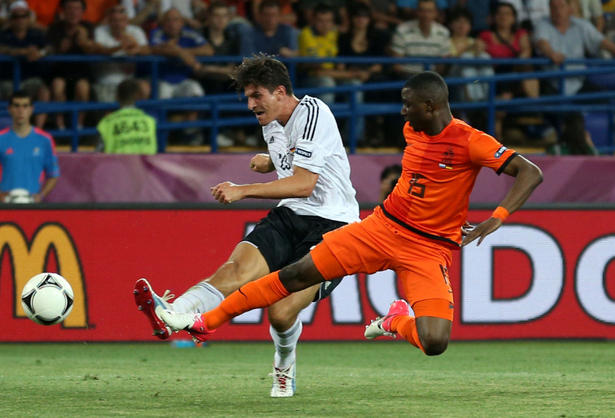
Julian Finney / Getty Images

It’s been a pretty great tournament so far. Lots of good games, a fair amount of goals, and all of the groups are still poised beautifully.

Group A
Russia has looked pretty good, Greece has been terrible (with some flashes of quality after they fall behind, Poland and the Czechs have showed flashes, but seem to clearly lag behind Russia. Greece is not technically out, but they’re probably going to get stomped by Russia. Which means it’s a win-or-go-home game for the Polish against the Czechs. I’d make them marginal favorites, but that could really go either way.  For Russia, Arshavin has been REALLY good, just like he was four years ago in this tournament. Apparently, he only truly shows up for the Euros. It seems like he’s put in more work in these two games than he did his entire Arsenal career.

Group B
Germany haven’t looked fantastic, but have certainly got the job done. They’re the only team with 6 points in the tournament, and seem quite likely to make it 9 in their final game against Denmark. They outclassed the Dutch, and did the necessary job against Portugal. While they haven’t really impressed like we might have hoped, they’re likely to win the ‘Group of Death’ at a canter. So you wouldn’t want to bet against them winning the whole thing. Denmark has been good, but probably not quite good enough. They really needed a point from Portugal. Portugal are clearly the best-placed to finish second in the group, but the Dutch aren’t out of it yet.  The Portugal-Netherlands match promises to be incredibly tense.

My pre-tournament prediction for Van Persie to win the Golden Boot is not looking good. He’s been incredibly wasteful. Still, he picked up one goal against Germany. And if the Dutch do get out of this, it will probably be because he turns in a performance like he’s been giving Arsenal. My other pre-tournament prediction was Ozil as the player of the tournament. That one is still looking plausible. He was magnificent in the first game and decent in the second.

Group C
Spain are still Spain. They can frustrate a bit, when all the passing seems to produce very little. Still, Italy was very good against them, and still only got a point. And they just dismantled Ireland, which was not that surprising but still was a pretty good performance. Italy and Croatia played a very intriguing game, one in which both sides seemed torn about whether to try for the win or settle for the draw. Italy are probably the slight favorites to advance. You’d bet on them to also beat Ireland, which would mean Croatia would need at least a draw from Spain. And even a draw might not be enough if Italy can beat Ireland by 3 goals. I’ve been impressed by all three of the non-Irish teams in this group. Croatia has looked very threatening and deft with the ball. Italy’s 3-5-2 formation has been solid and given them some fluidity. Spain are Spain.

Group D
France are in control, only needing a point from the eliminated Swedes to go through. In fact, there’s a very good chance this one will finish in exactly the order I predicted (France, England, Ukraine, Sweden). For England, it’s hard to see them advancing past the quarterfinals unless they can tighten up their defensive arrangement. But with four points, they only need a draw against Ukraine to guarantee going through. And they’ll have Rooney back. So it’s still possible.

Best games:

Poland 1 – 1 Greece
Potentially ruined by a terrible referee, who sent off a Greek player for two ‘fouls’ that shouldn’t have produced one yellow, much less two. It looked at that point like Poland was going to cruise to a victory, but instead Greece came roaring back. The keeper being sent off and his replacement immediately saving a penalty was a fantastic moment. Poland were a bit bipolar in this one, showing some serious quality in the first half and looking like a pub team who stumbled onto the field in the second half.

Spain 1 – 1 Italy
Wonderful skill on display in a very cagey match. Italy showed that Spain can be challenged effectively without simply parking the bus. And Spain showed that even against good competition playing well, they are still a serious force.  Probably the most skillful game of the tournament so far.

Denmark 2 – 3 Portugal
Some beautiful goals in this one. The Postiga goal was just lovely, the Bendtner efforts were nice.  Even (grrr) Pepe gave a good showing.  Denmark recovers from being down two goals, and then Portugal put them away in the final couple minutes. Riveting stuff.

England 3 – 2 Sweden
Not a particularly well-played game, but tremendously entertaining. England conceded two very silly goals, but scored a couple beauties. Walcott decided to turn up and be the good Walcott in the game against Sweden, rampaging through the Swedish defense, scoring goals and setting them up. Overall, it was just end-to-end madness.

Surprises:
– The revenge of the overpriced Premier League strikers. Torres had a couple classic Torres miscues in his first game, but has looked incredibly dangerous throughout, and added a couple goals against Ireland.  He’s looking much more like the Torres who was arguably the best striker in the world and much less like the guy who couldn’t score for 1000 straight minutes this year.  Meanwhile, Andy Carroll was a serious handful in his game, and notched a very solid goal. And in a serious blast from the past, Shevchenko got a brace in Ukraine’s opener.
– The Netherlands. They haven’t been terrible, but they really haven’t been good, either. They could still get out of the group and turn on the afterburners, but they have really dug a hole for themselves. I suppose Denmark counts as a surprise, too, as the reverse of this. But they did get outplayed and still probably won’t make it out of the group.
– My predictions. While I’ve gotten a fair number of the individual games wrong, it looks reasonably likely that every team I predicted to top the group will do so, and all the teams I predicted to finish last to do so. And it’s still not particularly unlikely for all four groups to finish precisely as I guessed. Considering how poor I often am at this stuff, that would be a real shock.
– GOALS! No 0-0 result so far, and it’s just been a pretty open tournament in general.
– Zlatan. Not a ‘surprise’ really, but he has been really good. He never quite became the world-class player that he was supposed to be, but he’s really not far off. Sweden are out, but it has nothing to do with him. He was just immense in both of their games.
– Ribery is an incredibly aggravating player. Oh wait, that’s not remotely a surprise. I freaking hate Ribery.


Posted in Uncategorized | Leave a comment

Perfect from now on

Perfect Day – Lou Reed
Perfect Lovesong – The Divine Comedy

My friend Ben wanted to see a game this week, so we talked about the Wednesday night one or the Thursday afternoon one. The Thursday one had the advantage of being unlikely to freeze us to death. But then he said, ‘rotation looks like it puts Cain on Wednesday night. I’d rather see him than Zito.’ Talk about good calls.

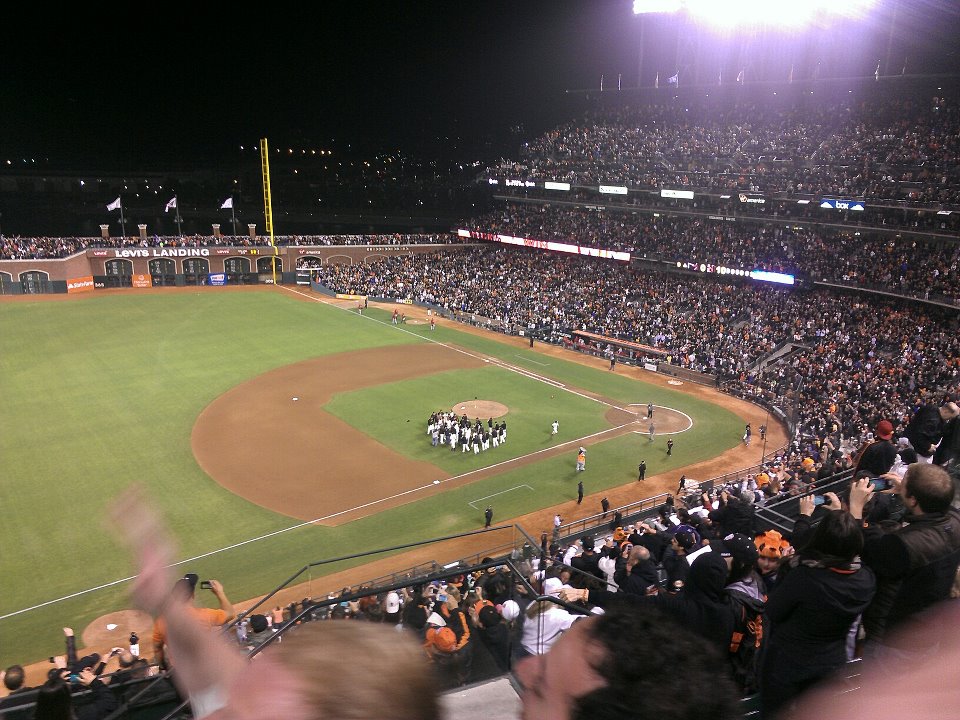
We got 5 buck tickets on Stubhub, grabbed some burritos in the Mission, and made our way over. Caroline and one of her friends met us there and we settled in for the game. About five minutes before the game started Ben predicted a 15 strikeout game. When Cain struck out 5 of the first 9 batters, I told him we were on pace. And in the back of my mind I thought ‘9 up, 9 down, and he’s dealing…’

By the fifth inning we started to give each other knowing glances. And we had serious difficulty trying to explain the magnitude of the situation to Caroline and her friend without violating the code of silence about such events. She got that he hadn’t allowed any hits, but didn’t really understand that this was actually far more impressive than just that.

We were really starting to worry about his pitch count. The Astros had fouled off a lot of balls, and those strikeouts really add up. So we started to speculate about a 130/140 pitch game.

In the sixth inning, the Giants were already up like 15-0 so they started subbing in defensive players. Cain struck out Bogusevic for his 10th K. Then Snyder gave the ball a serious ride out to left. From our vantage point, it looked like a HR. But no, the catch was made right at the wall! And Cain struck out some guy I’d never heard of for his 11th K to end the inning.

The seventh inning led off with that magnificent catch by Gregor Blanco. Full stretch, laid out in deep right-center. From our perspective way on the other side of the field, it looked like the ball was jarred loose when he landed, so when the ump raised his right fist we went totally bonkers. Then Cain got two more Ks and that was that.

The Giants halves of these innings were torture. People clearly still wanted to support the team, but given the massive lead, there was really no doubt about the win. So we really just wanted Cain back out there. It seemed like the Giants hitters were on board with this, as they started swinging at most anything close.

At this point, Caroline said something to the effect of: “Is this what it’s like to actually care about sports? I never really understood.”

In the 8th, Cain seemed totally pumped with adrenaline, overthrew a few pitches, and looked like he was in danger of giving up a walk or even hitting a guy. Never really seemed like the Astros would get a hit, though. When he went to three balls on Brett Wallace, my heart was pounding. After my teams having some very unpleasant losses to the other Brett Wallace, I wanted no part of THIS one ruining the perfect game. Fortunately, Cain rung him up on a full count pitch.

Up until that point I was incredibly nervous. When he came out for the 9th, though, I started to get a lot more calm. Given the quality of the hitters and Cain, it was more likely than not that he’d get them. And it just seemed clear it was going to happen. They hit a couple of weak fly balls to left, which was directly below us. Caroline was freaking out, but these were routine plays and were put away easily. Then, for the final out, it was a weak roller to third base. Fortunately, they had subbed out Sandoval. Arias double-clutched, but then made a strong throw. And it was over. Pandemonium. Jumping up and down. Screaming. Hugging.

I’ve never been to a playoff game, but the atmosphere at this one felt like game 7 of the World Series. On a 1-1 count in the 7th inning, a close pitch would get called a ball and the boos echoed around the stadium. People were standing and cheering for just about every 2-strike pitch from the 6th inning onward. Strangers were looking at each other and saying ‘can you believe this is happening?’ Someone near us tried to get up to go to the bathroom in like the 8th inning and their friends yelled at them to hold it.

I’m still sort of in awe. Tied for the most strikeouts ever in a perfect game. Second-best nine-inning game score in major league history (trailing only the Wood game). Of the tens of thousands of games in history, this was probably one of the 4 or 5 most dominant pitching performances. And I was there. On a five dollar ticket purchased on a whim a couple days ago.

I love baseball. And I’ll be a huge Matt Cain fan for the rest of my life.

Posted in Uncategorized | Leave a comment

Euro 2012: German Angst

Hi everybody, I’m Jan. First of all, many thanks to Charles for letting me write on his blog. I don’t know nearly as much about music as he does, but as a Euro-boy who has followed every European Championship since 1988 I may be able to contribute some interesting perspectives to his coverage of EURO 2012 in “Polkraine” (congrats to the British press for this gem of a coinage).

So, I am going to pretend to have missed the anti-German jibes in his previous post and will, consequently, focus mostly on the German team before their opening game against Portugal tomorrow.  Despite Germany’s reputation as an international football powerhouse it has actually been quite some time since the Nationalmannschaft was seen as the overwhelming favorite to win a big tournament (even though some people saw them as favorites in 2008). This current perception, however, seems much more prevalent abroad than in Germany itself where the mood is rather skeptical. (Full disclosure: I’m following the EURO from the US and my observations of the mood in Germany are based mainly on the compulsive reading of everything football related and personal conversations with friends at home.)

Now, why is it that “the Germans” are so doubtful about a team that they generally consider to be the most talented since the 1972 EURO champions? I think there are four main reasons:

(1) Many people feel that the current team didn’t have enough time to train and play together, in particular because the majority of the team had to play in the Champions League final a mere three weeks ago.

(2) The fear that the Bayern players – seven of which can reasonably hope to play in tomorrow’s opener – will suffer from some form of psychological trauma caused by them having finished second in all three club competitions this season.

(3) There is also the belief that Jogi Löw is going to rely too much on some of the more experienced players (e.g., Per Mertesacker and Miroslav Klose) even though they may not be fully fit to play and more promising alternatives (e.g., Mats Hummels and Mario Gomez) are available.

(4) There is a growing uneasiness about the general development of the national team. While everybody is happy that the dark ages of German football (1998-2004) seem to be gone for good, there is now a very clear demand for silverware and this is in turn connected to the question if the current generation – despite its abundant talent – has what it takes to win titles.

Well, I happen to think that a lot of this skepticism is warranted. Löw’s system is very dependent on so-called automatisms and I’m not sure that these will be readily available for a team that had less than two weeks to train together. The counterargument, of course, is that the core of the squad has been together for a long time and that most of the players know each other really well. We’ll simply have to wait and see which explanation holds true. I also think that the very long season, especially for Bayern, will have an impact on the team, not necessarily in mental terms, but possibly with regard to the overall fitness of the team.

With regard to individual players, I am convinced that Löw has his favorites and it just so happens that poor Mats Hummels is not among them. Fair enough, he hasn’t been his usual world-class self in the dozen or so caps he’s earned so far, but that’s no justification to play a barely recovered Per Mertesacker instead of him. If Klose is fully fit, on the other hand, he should clearly start instead of Gomez. Finally, I think Löw does a great job at preparing his teams for important games and he has them play very attractive football, but his individual decisions are not beyond reproach. After all, he had Piotr Trochowski start in a World Cup semifinal.

The last point I want to look at in more detail is the perception of the relationship between style and success. Again, most people in Germany are very happy that the national team plays attractive football. However, people are also very tired of finishing second or third. Sure, that would be a great result for most countries, England in particular, but a country that has won six trophies since 1954 is simply used to winning a big one every dozen years or so. (It’s been 16 long years.)

Now, in the past, of course, Germany often played very unattractive football and ended up winning nevertheless. That’s pretty much what Germans did; the very definition of Germanness and German football, even though this was highly unfair with regard to some of the great German teams of the past that played very attractive football. In the last three tournaments, however, Germany played very well, even great at times, and didn’t win anything but the grudging respect of the foreign press and the ecstatic celebrations of the millions of German fans in the streets who don’t really care about football, but want to have an excuse to party and get wasted.

“Has Germany become the new Holland?” people ask with fear in their eyes. Do Lahm, Schweinsteiger, Klose, Podolski and Özil have what Breitner, Beckenbauer, Gerd Müller, Sammer and Matthäus had in excess? Guts. Cojones. Löw would say you don’t need this old-fashioned stuff anymore; the system will take care of everything. Look at Spain or Barça, he would point out with that smug smile of his. And completely forget about Puyol.

Prediction for tomorrow:

Holland 2 – Denmark 1

Germany 3 – Portugal 2

Posted in Uncategorized | Tagged | Leave a comment